


Forum Replies Created
- AuthorPosts
-
A food festival in order to promote entrepreneurship in women’s breast was held Sunday in Luanda, by the Organization of Angolan Women (OMA).

At the opening, the national executive secretary of OMA, Luísa Damião, said the festival is a clear demonstration that the national cuisine is a means of identification of a people, because through it becomes possible to know the history, identity, habitsand customs of this people.
He noted that it is also time for reflection on the need to cement increasingly unity, friendship and brotherhood and the spirit of solidarity and the feeling of love of neighbor.
The family must continue to share ideas, concerns and aspirations aware that culture strengthens the nation, said the official.
It stressed that the holding of this festival in a very difficult year for the Angolan economy, the WCO should continue to play an important role with the militant mass and of women in general in promoting enlightenment campaigns on the economic and financial situation of the country,due to low oil prices in the international market.
We must continue to work on women’s awareness so that they develop innovative projects that contribute to the diversification of the national economy and promote entrepreneurship within the company, said Luísa Damião.
On the other hand, explained that tourism in Angola is also a source of diversification of our economy.
The executive secretary of OMA took the opportunity to appeal the mobilization of all women around the tasks prior to the 6th Congress of the WCO to can achieve the expected success.
The festival brought together women from various social was held under the 6th Congress of OMA taking place from 2 to 5 next March and had the participation of 18 provinces.
Angola joined the African initiative elephant protection, which aims to enhance the methods, strategies and tactics to combat poaching and the networks trafficking in illegal ivory trade.
The initiative promoted by the States and Governments of Botswana, Chad, Ethiopia, Gabon and Tanzania, defines a set of objectives and priority actions to be implemented by the countries in which live elephants, have a key role in reversing the current frame, according to a notepress the Ministry of Environment, sent today to the Lusa agency.
The Angolan authorities consider joining the initiative “a clear demonstration of the seriousness with which faces the question and a great reinforcement opportunity to all the effort we have undertaken to address this situation.”
According to the document, Angola efforts include mobilizing support in relation to inspection work inside and outside of conservation areas, the training of national cadres, the drafting of specific legislation, among other actions.
More than half the land area of Angola is habitat of elephants in and outside of protected areas, implying its management information and sharing experiences with other African states.
The technical-material and human conditions are created for the academic year 2017 will start this Monday, March 7, at the top polytechnic school of Mbanza Congo, northern Zaire province.
The guarantee was given on Saturday to ANGOP, the deputy dean for academic area, Cecilia Chibinda, adding that the institution enrolled 386 new students who joined the thousand and 685 former students.

Academic informed that, for the moment, the school has 35 teachers, among national and foreign (Cuban).The higher education institution, which exists since 2010, is part of the third academic area of the university on November 11, based in Cabinda province.
Courses as teaching Mathematics, Physics, Chemistry, Psychology and Business Management are taught in this institution, which meets in three shifts, morning, afternoon and after work.
The fact that most teachers (national) be in the condition of employees was appointed as the great difficulty.
The Black List
The FARC-EP were described by the USA as a terrorist organization in 1997, a decision that was ratified on November 2, 2001. The European Union followed them in 2002, after the failure of peace talks with President Pastrana. In Latin America, however, only Peru and Colombia consider the FARC a terrorist organization.There is no internationally unified criterion on what means to be a terrorist. What concept guides these lists? Actually, the inclusion of an organization in the list corresponds to state interests, political alliances and economic needs”. In the list there are many insurgent organizations and it completely ignores the existence of State terrorism, principal source of terror in many countries, for example … .in Colombia.
<h2 class=”itemTitle”>Forum on End of Conflict in Colombia</h2>
On February 10, the last one of the forums organized by the UN and the National University of Colombia ended in Bogota. The forum had been organized atthe request of the peace delegations of the National Government and the FARC-EP in order to collect proposals and perceptions of society on items 3 and 6 of the Agenda, concerning End of Conflict and Implementation, Verification and Endorsement.
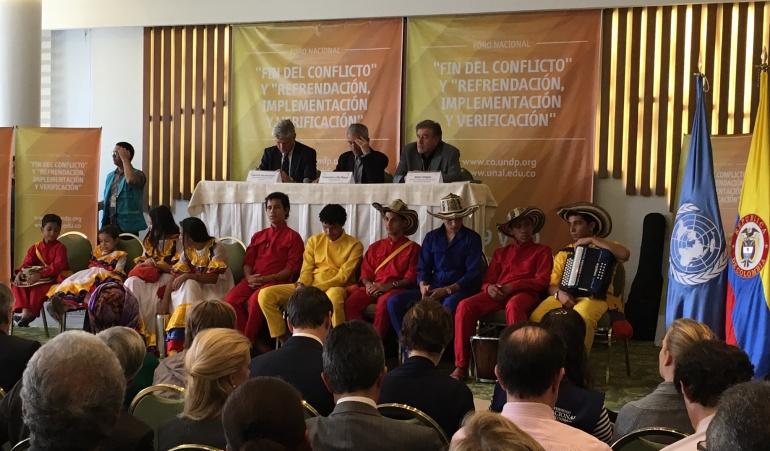
So far, these forums have been an important input for the discussions in Havana; likewise, this last forum, with participation of about 700 people, presented a multiplicity of proposals that were discussed during three days at different workshops. Discourses and written proposals made by social organizations from all over the country, panelists and experts in the field, will be collected by the organizers of the event and brought to Havana in the course of next week.
Thus, bilateral ceasefire, accurate treatment to the phenomenon of para-militarism, mechanisms to ensure the support and backing of civil society to the implementation of the agreements, the strengthening of the judicial system and the solution to the prison crisis were some conclusions of the forum, in which people demanded a bilateral solution on the definition of a mechanism to endorse the Final Agreement, contrary to the government’s unilateral intention to impose a plebiscite, which goes against the terms of the Agenda approved by both sides in 2012.
February 29, 2016 at 11:56 pm in reply to: Revolutionary Armed Forces of Colombia- People’s Army #738Just one side of the conflict
By: Marco Leon Calarca, member of the Peace Delegation of the FARC-EP
The talks in Havana between the Colombian government and the FARC-EP are coming closer to its objective:
A Final Agreement, allowing us to close the long period of violent confrontation that has ended up in death, dispossession, displacement and an immense pain for the country. To that extent the situation becomes more risky, since the enemies of reconciliation are redoubling their efforts to hinder and lead to failure a national purpose.
The insane actions of military provocations in order to accuse the guerrillas of breaking their peace commitments are threats to the peace process, set up in such a way that they generate media scandals and make it impossible for the parties to find a lasting solution. This situation is well known and preventive measures are being taken.
Another practice is the persistent manipulation of information, sometimes even disguised as an effort to contribute to the process (and this is not about restricting freedom of expression, for we should always remember that it must be based on uncontrolled and sufficient information).
To insist on the absolute responsibility of the guerrilla –besides ignoring the reality evidenced for example in the conclusions of the Historical Commission of the Conflict and its Victims-, is a manipulation aimed at warding off chances of forgiveness and reconciliation.
To declare that the guerrilla has killed, ambushed, kidnapped, burned down or displaced, are tendentious statements, which among others, is precisely what is to be overcome since they constitute acts of war. In many ways the guerrillas accept their responsibilities, stating that its target is not, and has never been, to harm their own people. Yet, nothing is said about the responsibility of the state and its military and paramilitary forces; as we have pointed out: that’s seeing only one side of the issue.
To make matters worse, and as a slanderous way to explain the degradation of war, the media insist on reporting an alleged loss of the insurgency’s political orientation, even pointing out a supposed discontinuity of the noble ideals of the founders of the FARC-EP; what a paradox! They forget that even before the FARC’s uprising, resistance forces were labeled as bandits.
A sly way of presenting things, with half-truths and biased surveys showing little support for peace and highlighting the “infinite mistrust” of people with the FARC. Lies, which are presented as unbeatable obstacles for the peace talks and which won’t take them anywhere. This way, things will remain the same, with huge benefits for those who profit from war: a powerful minority.
The majority of the people are hoping for peace; a majority that identifies with the process and participates in one way or another; suffering the rigors of war and its economic, political, social and cultural consequences; people, who also understand that the problem is not about weapons and much less about the weapons of their insurgent defenders. This majority is intended to be hidden in the name of democracy. This situation is part of what we need to resolve, the ability of the majority to express themselves, to inquire, to speak.
Peace is – and will be- a conquest of the whole of Colombian society, men and women,side-by-side,Âbuilding it: effort, sweat and surely even tears will be shed in order to finally enjoy the society we deserve.
Note:
Joy, celebration and even a party were invented to hide the fiasco of Plan Colombia. What a shame!February 29, 2016 at 11:54 pm in reply to: Revolutionary Armed Forces of Colombia- People’s Army #737Expert: FARC Must be Free to Tour Colombia for Peace to Triumph
Carlos Medina Gallego says Colombians who have doubts about the peace process can only be won over with the help of the rebels.
In response to the controversy over the visit of leading members of the Revolutionary Armed Forces of Colombia to a the town of El Conejo, Carlos Medina Gallego, an expert on the internal conflict in Colombia, argues that — instead of hindering these kinds of visits — dialogue between rebels and the public should be encouraged.
Gallego, a professor at the National University of Colombia who has written extensively about the armed conflict, told Contagio Radio in an interview Saturday that the success of the peace process depends on the Colombian public feeling confident that an agreement will actually bring peace to the country.
For Gallego, the only way that will happen is if all parties can freely visit and talk with communities to convince them that the peace process should be trusted.
Talks between the government of Juan Manuel Santos and the Revolutionary Armed Forces of Colombia, known as the FARC, have been ongoing since 2012 and are in their final phase, with a deal expected to be signed in late March.
However, the peace process has hit what analysts inside Colombia consider to be one of its most significant stumbling blocks, after news emerged that members of the FARC peace delegation visited a town alongside armed combatants.
Right-wing politicians, such as former president and current Senator Alvaro Uribe, called the actions of the FARC “armed proselytism.”
The FARC responded by saying that it was an “unwarranted controversy” generated by politicians who have always opposed the peace process.
Gallego agreed with the FARC, saying that there are politicians who deliberately exaggerate these kinds of incidents in order to “show there are shortcomings in the process.”
Nonetheless, the Santos government responded to the controversy by banning FARC peace negotiators from visiting their camps.
Gallego argues that this is the wrong strategy. He believes that not only should the FARC be allowed to visit their guerrilla camps, but that they should also visit other communities to promote the peace process, just as the government does.
“The communities have many doubts, they have uncertainties about the process that will follow the signing of the agreement and the reach of the agreement,” said Gallego.
“Who better than the FARC — who have been operating in those territories, who maintain a relationship with the people of those territories — be those who illustrate the benefits the peace process and the realities of the agreements … to the population in the areas where they have been and where the conflict has taken place,” he said.
According to Gallego, who works closely with communities affected by the armed conflict, residents are concerned that the vacuum left by the exit of armed FARC combatants will be filled by right-wing paramilitary forces.
Residents must feel confident this will not occur in order to win their support for the peace process, argues Gallego, thus the intervention of the FARC is indispensable.
“I believe it is important that the negotiating table … come to an agreement to create a unified communicative discourse directed at Colombian society,” said Gallego.
As for the controversy over the appearance of FARC leaders alongside armed guerrillas, Gallego reminded the public there is no bilateral cease-fire in place. “The FARC are under a unilateral cease-fire … and it would not have been prudent for this organization to have attended as if they were covered by a bilateral cease-fire and as if there was zero risk,” he said.
Despite the controversy over the presence of armed combatants, the tone of the event with the FARC delegation was decidedly festive, with speeches emphasizing the coming and much hoped for peace.
February 29, 2016 at 11:50 pm in reply to: Revolutionary Armed Forces of Colombia- People’s Army #736Condolences to the family Castro Ruz
Compañeros:
FIDEL CASTRO RUZ.RAÚL CASTRO RUZ.With deep regret we are writing to you on the occasion of the regrettable death ofcompañero RAMÓN CASTRO RUZ, historical militant of the cause of the people of Cuba and all Our America.
Through this letter we send our sincere condolences for such deep loss, extended to the whole family Castro Ruz and all the Cuban people: our solidarity in these painful moments. We are confident that the legacy of compañero Ramón will be kept alive in the fight for socialism and in the coming generations that will assume the historical tasks of the revolution.
Yours sincerely,
Secretariat of the Central High Command of the FARC-EP.
February 29, 2016 at 11:46 pm in reply to: Revolutionary Armed Forces of Colombia- People’s Army #735Statement by Cuba and Norway, guarantor countries of the peace talks between the government of Colombia and the FARC-EP
Cuba and Norway, guarantor countries at the Negotiating Table between the Government of Colombia and the Revolutionary Armed Forces of Colombia-People’s Army (FARC-EP), announce to the public that, as a result of consultations made in the last few days with the participation of the Ministers of Foreign Affairs of Cuba and Norway, an agreement has been reached to overcome recent difficulties and normalize the talks between the parties in Havana.
The parties will continue to comply with the commitments made with regard to measures of de-escalation and confidence-building.
The Guarantors welcome the firm commitment of the Government of Colombia and the FARC-EP to continue to make progress so as to achieve a final agreement soon.
Cuba and Norway thank the Government of Colombia and the FARC-EP for the confidence they have shown in the Guarantors and the constructive spirit in which both parties contributed towards the positive results we are announcing today.
Cuba and Norway reaffirm their commitment to continue contributing to the progress of the talks and to the achievement, in the shortest possible time, of a final agreement to end the conflict and build a stable and lasting peace in Colombia.
- AuthorPosts


